Introduction
As businesses grow, managing finance, inventory, sales, manufacturing, purchasing, and customer relationships using multiple disconnected systems becomes increasingly difficult. Manual processes, spreadsheets and outdated software often create delays, errors, and poor decision-making.
This is where Microsoft Dynamics 365 Business Central changes the game.
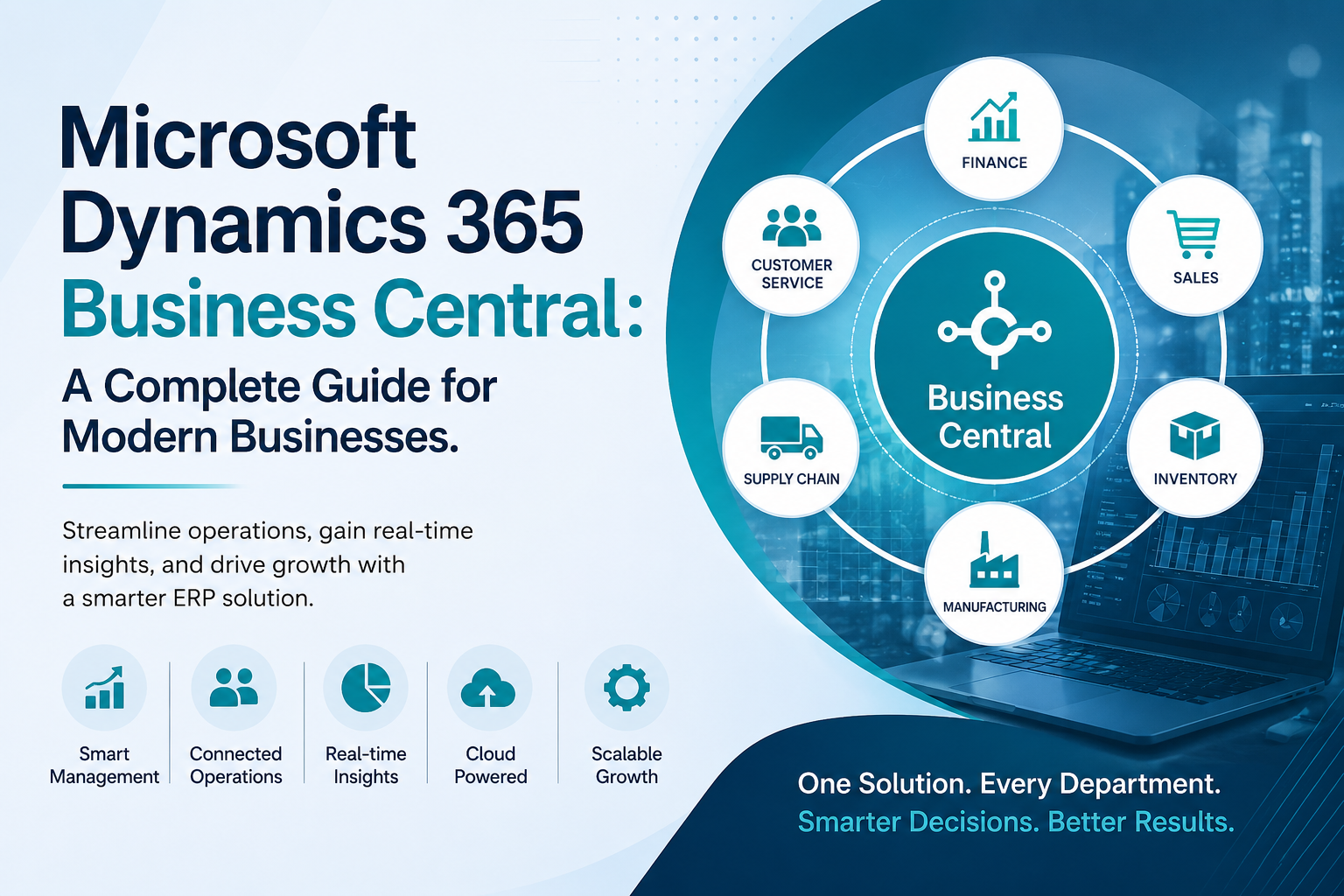
Designed for small and medium-sized businesses as well as growing enterprises, Microsoft Dynamics 365 Business Central brings every critical business function together into one intelligent platform. From finance and inventory to manufacturing and customer service, it helps organizations streamline operations while providing real-time business insights.
In this article, you'll learn what Microsoft Dynamics 365 Business Central is, its key features, benefits, implementation process, real-world applications, advantages and limitations, and how businesses can maximize their ERP investment with the right implementation strategy.
What is Microsoft Dynamics 365 Business Central?
Microsoft Dynamics 365 Business Central is Microsoft's comprehensive cloud-based Enterprise Resource Planning (ERP) solution. It helps businesses automate operations, improve productivity, and make data-driven decisions through a single integrated platform.
Originally developed from Microsoft Dynamics NAV, the platform has evolved into a modern cloud ERP that integrates seamlessly with Microsoft products such as Microsoft 365, Teams, Excel, Outlook, Power BI, Azure Cloud, and the Power Platform.
Unlike traditional ERP systems that require heavy infrastructure investments, Business Central offers flexibility, scalability, regular updates, and enterprise-level security without the complexity of maintaining on-premise servers.
Whether you're managing inventory, manufacturing, distribution, finance, or customer relationships, Business Central provides a unified solution that grows with your business.
Why Are Businesses Choosing Business Central?
Modern organizations need more than accounting software. They require a complete business management solution that connects departments and delivers real-time information.
Some of the biggest reasons companies are adopting dynamics business central include:
Centralized financial management
Automated business processes
Real-time reporting and dashboards
Improved inventory visibility
Better customer relationship management
Secure cloud infrastructure
Easy integration with Microsoft applications
AI-powered business insights
Instead of switching between multiple software platforms, employees can work from one connected system.
Key Features of Microsoft Dynamics 365 Business Central
Financial Management
Business Central provides powerful financial tools that simplify accounting and improve financial visibility.
Key capabilities include:
General ledger
Accounts payable and receivable
Cash flow forecasting
Budget management
Fixed asset management
Bank reconciliation
Financial reporting
Finance teams can generate reports instantly while maintaining compliance and accuracy.
Inventory Management
For businesses handling physical products, inventory management is one of the biggest operational challenges.
Business Central helps organizations:
Track stock in real time
Manage multiple warehouses
Monitor inventory levels
Reduce stock shortages
Optimize purchasing
Improve demand forecasting
Companies looking for reliable inventory management software India can benefit significantly from these capabilities.
Manufacturing Management
Manufacturers need complete visibility across production, procurement, quality, and inventory.
Business Central supports:
Production planning
Bill of Materials (BOM)
Capacity planning
Machine center management
Production orders
Material requirements planning
Shop floor management
This makes it one of the preferred solutions for organizations seeking manufacturing ERP software India.
Sales and Customer Service
The platform helps sales teams improve customer experiences through:
Sales order management
Customer history
Quote generation
Contact management
Pricing management
Customer support tracking
Sales representatives can access customer information from anywhere, improving responsiveness and service quality.
Supply Chain Management
Business Central improves supply chain efficiency through:
Purchase order automation
Vendor management
Shipment tracking
Warehouse operations
Demand planning
Procurement optimization
Organizations handling complex logistics can also use Business Central as an effective erp software for logistics industry.
Project Management
Service-based businesses can efficiently manage projects with features like:
Resource allocation
Budget tracking
Time sheet management
Project costing
Progress monitoring
How Business Central Uses Azure Cloud
One of the biggest strengths of Business Central is its foundation on Azure Cloud.
Azure provides:
Enterprise-grade security
High availability
Automatic backups
Disaster recovery
Global accessibility
Continuous updates
Businesses no longer need expensive server infrastructure while benefiting from Microsoft's trusted cloud ecosystem.
AI and Automation with Power Platform
Business Central becomes even more powerful when integrated with the Power Platform.
Organizations can build:
Automated workflows using Power Automate
Custom business apps with Power Apps
Interactive dashboards using Power BI
AI-powered virtual assistants
Together, these tools eliminate repetitive tasks and improve decision-making across departments.
Enterprise AI Solutions for Smarter Decisions
Artificial Intelligence is transforming ERP systems.
Business Central includes intelligent capabilities that support modern Enterprise AI solutions, such as:
Sales forecasting
Cash flow prediction
Inventory optimization
Late payment prediction
Demand forecasting
Automated financial insights
Rather than reacting to business problems, companies can anticipate challenges before they occur.
Microsoft ERP Solutions That Grow with Your Business
Many businesses start with basic accounting software and later realize it cannot support expansion.
Business Central belongs to Microsoft's family of microsoft erp solutions, designed to scale alongside business growth.
As organizations expand into new markets, add warehouses, increase product lines, or open multiple locations, the platform can handle growing operational complexity without requiring a complete software replacement.
ERP Implementation: What Businesses Should Know
Successful erp implementation is about more than installing software.
A structured implementation generally includes:
Business Analysis
Understanding current processes and identifying operational gaps.
Planning
Defining project scope, timelines, and implementation goals.
System Configuration
Customizing workflows, approvals, financial structures, and business rules.
Data Migration
Safely transferring customer records, inventory, vendor data, and financial information.
User Training
Helping employees understand the new system through practical training.
Go-Live and Support
Launching the ERP with continuous monitoring and post-implementation support.
Working with experienced dynamics 365 business central partners can significantly reduce implementation risks and ensure smoother adoption.
Business Central Across Different Industries
Business Central supports businesses across various industries.
Manufacturing
Manufacturers gain better production planning, inventory visibility, procurement control, and quality management.
Wholesale Distribution
Distributors benefit from improved warehouse operations, purchasing automation, and inventory optimization.
Retail
Retail businesses can manage inventory, sales, customer information, and financial reporting from one platform.
Logistics
Companies searching for reliable erp software for logistics industry can streamline transportation, inventory movement, warehouse management, and shipment tracking.
Professional Services
Consulting firms and service organizations can efficiently manage projects, billing, resources, and financial performance.
Real-Life Example
Imagine a growing manufacturing company operating across three cities.
Before implementing Business Central, the company faced several challenges:
Inventory shortages
Duplicate data entry
Delayed financial reports
Manual purchase approvals
Limited production visibility
After implementing Microsoft Dynamics 365 Business Central:
Inventory accuracy improved significantly.
Financial reports were generated much faster.
Purchase approvals became automated.
Production scheduling became more efficient.
Management gained access to real-time dashboards for informed decision-making.
While results vary depending on implementation and business processes, this example reflects the type of operational improvements many organizations experience after adopting a modern ERP platform.
Pros of Microsoft Dynamics 365 Business Central
Easy integration with Microsoft 365 ecosystem
Cloud-based accessibility
Strong security through Azure Cloud
Real-time business insights
Scalable for growing businesses
AI-powered reporting and forecasting
Comprehensive financial management
Strong manufacturing capabilities
Regular Microsoft updates
Suitable for multiple industries
Cons of Microsoft Dynamics 365 Business Central
Initial implementation requires careful planning.
Employee training is essential for successful adoption.
Customizations may increase project costs.
Some advanced business requirements may require third-party extensions.
Data migration from legacy systems can be time-consuming.
Despite these considerations, the long-term operational and financial benefits often outweigh the initial investment.
Frequently Asked Questions
Is Microsoft Dynamics 365 Business Central suitable for small businesses?
Yes. It is specifically designed for small and medium-sized businesses while also supporting growing enterprises.
Is Business Central only available on the cloud?
No. While most businesses choose the cloud version, on-premise deployment options are also available depending on business requirements.
Can Business Central integrate with Microsoft Office?
Yes. It integrates seamlessly with Outlook, Excel, Microsoft Teams, Power BI, and other Microsoft applications.
How long does ERP implementation usually take?
The implementation timeline depends on business size, process complexity, data migration requirements, and customization needs. Smaller projects may take a few weeks, while larger implementations can take several months.
Why should businesses work with Dynamics 365 Business Central partners?
Experienced dynamics 365 business central partners provide implementation expertise, training, customization, integration support, and ongoing maintenance, helping businesses achieve faster and more successful ERP adoption.
Why the Right Implementation Partner Matters
Choosing the right technology partner is just as important as selecting the ERP itself.
An experienced implementation partner understands business processes, minimizes project risks, provides industry-specific guidance, and ensures the solution aligns with long-term business objectives.
Rivira Systems helps organizations implement Microsoft Dynamics 365 Business Central with a structured, business-focused approach. From consultation and implementation to customization, integration, training, and post-deployment support, the focus remains on helping businesses achieve measurable operational improvements rather than simply deploying software.
Conclusion
Modern businesses need more than isolated software applications. They need a connected system that provides visibility, automation, intelligence, and scalability.
Microsoft Dynamics 365 Business Central delivers exactly that. By bringing finance, inventory, manufacturing, sales, supply chain, and customer management into a single platform, it enables organizations to improve efficiency, reduce manual work, and make faster, data-driven decisions.
Whether you're exploring manufacturing ERP software India, searching for advanced microsoft erp solutions, improving inventory management software India, or planning your first erp implementation, Business Central offers a future-ready platform capable of supporting sustainable business growth.
If you're considering implementing Microsoft Dynamics 365 Business Central, partnering with experienced professionals like Rivira Systems can help ensure a smooth transition, maximize ROI, and unlock the full potential of your ERP investment.
Ready to modernize your business operations? Contact Rivira Systems to discuss your ERP requirements, explore how Microsoft Dynamics 365 Business Central fits your business goals, and take the first step toward smarter, more connected business management.


Write a comment ...