Introduction
Running a growing business is exciting, but it also comes with increasing operational challenges. Managing inventory, finances, sales, purchasing, production, and customer relationships through multiple disconnected systems often leads to inefficiencies, errors, and missed opportunities.
This is where Microsoft Dynamics 365 Business Central becomes a game-changer. Designed for small and medium-sized businesses as well as growing enterprises, it brings together every critical business function into one intelligent, cloud-based ERP platform.
Whether you're looking for a smoother erp implementation, better financial visibility, or a scalable solution for manufacturing and distribution, Business Central offers a future-ready platform that adapts to your business needs.
In this article, you'll learn what Microsoft Dynamics 365 Business Central is, its key features, benefits, real-world applications, implementation best practices, and how businesses across industries are using it to improve productivity and profitability.
What Is Microsoft Dynamics 365 Business Central?
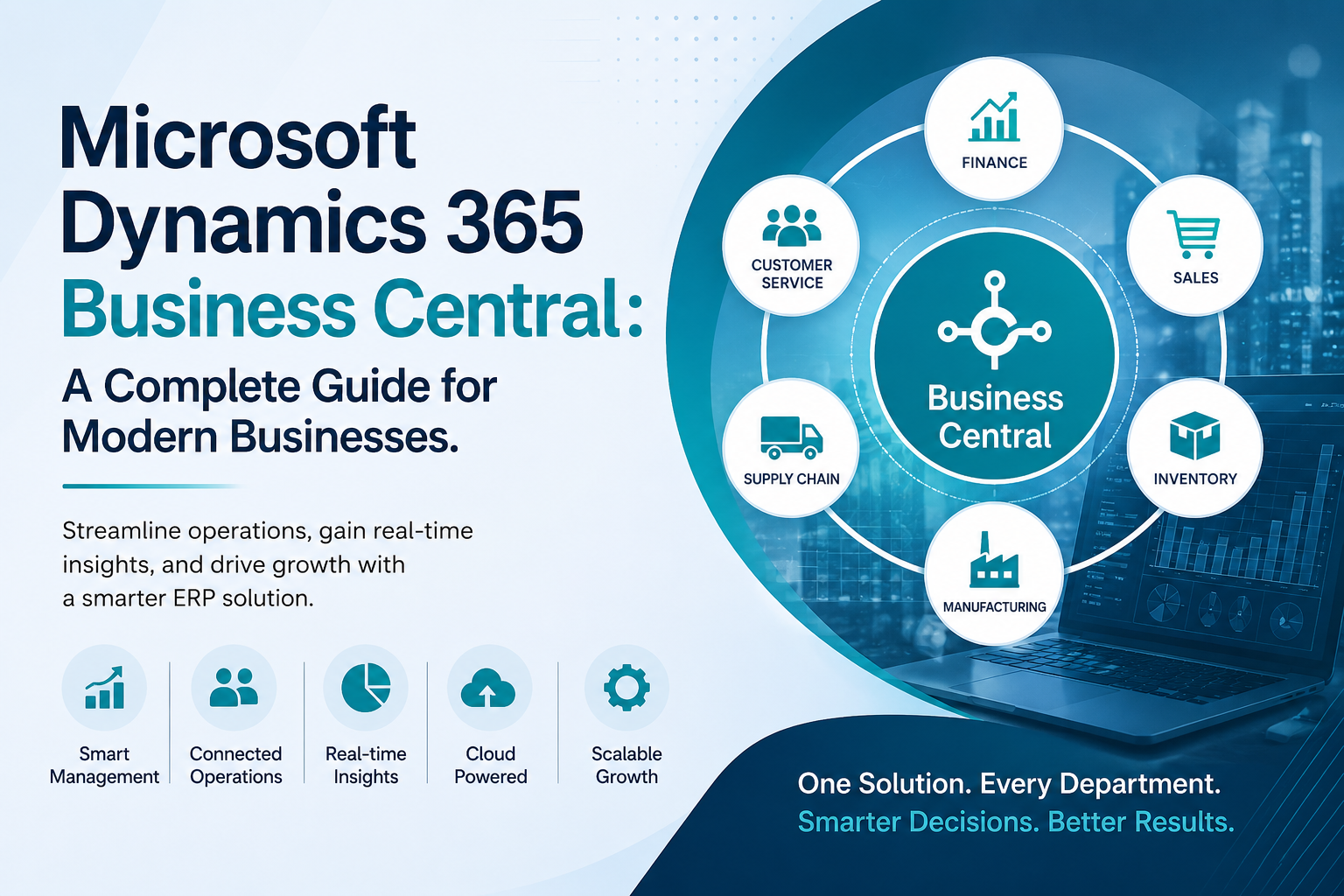
Microsoft Dynamics 365 Business Central is Microsoft's comprehensive Enterprise Resource Planning (ERP) solution that helps organizations manage finance, operations, supply chain, inventory, manufacturing, sales, purchasing, customer service, and reporting from a single platform.
Previously known as Microsoft Dynamics NAV, Business Central represents the next generation of intelligent Microsoft ERP solutions, combining the reliability of traditional ERP with the flexibility of cloud technology.
Unlike conventional ERP systems that often require separate software for different departments, business central unifies business processes, enabling teams to work from one source of truth.
The platform also integrates seamlessly with Microsoft 365 applications like Outlook, Excel, and Teams, helping employees work more efficiently without switching between multiple applications.
Why Businesses Are Choosing Dynamics Business Central
Modern businesses need more than accounting software. They need a connected system that supports growth while providing real-time visibility.
Here are some of the biggest reasons organizations are investing in dynamics business central.
Complete Financial Management
Business Central simplifies accounting by automating financial processes such as:
General ledger management
Accounts payable and receivable
Cash flow forecasting
Budget planning
Financial reporting
Tax management
Fixed asset management
Real-time dashboards allow business leaders to monitor financial health and make informed decisions quickly.
Smarter Inventory Management
Managing inventory manually often leads to stock shortages, excess inventory, and higher operating costs.
Business Central offers intelligent inventory capabilities including:
Real-time stock tracking
Automated replenishment
Warehouse management
Batch and serial number tracking
Demand forecasting
Multi-location inventory management
For organizations searching for reliable inventory management software India, Business Central provides powerful features that support local businesses as well as global operations.
Efficient Supply Chain Management
Supply chain disruptions can directly impact customer satisfaction and profitability.
Business Central helps organizations improve supply chain performance by enabling:
Purchase order automation
Vendor management
Demand planning
Shipment tracking
Procurement optimization
Warehouse coordination
Businesses gain greater visibility across their entire supply chain while reducing delays and unnecessary costs.
Microsoft Dynamics 365 Business Central for Manufacturing
Manufacturers require much more than basic accounting software. They need accurate production planning, inventory control, quality management, and cost tracking.
This is why many organizations searching for manufacturing ERP software India choose Microsoft Dynamics 365 Business Central.
Key manufacturing capabilities include:
Production Planning
Businesses can schedule production orders, allocate resources, monitor machine capacity, and reduce downtime.
Bill of Materials Management
Manufacturers can maintain accurate product structures while tracking raw materials and production costs.
Shop Floor Control
Real-time production monitoring improves efficiency and helps identify bottlenecks before they become major issues.
Quality Control
Integrated quality management ensures products meet standards while minimizing waste and rework.
These features help manufacturers improve operational efficiency while maintaining profitability.
Simplifying ERP Implementation
One of the biggest concerns businesses have when adopting new software is the complexity of erp implementation.
Fortunately, Microsoft Dynamics 365 Business Central offers a structured implementation approach that minimizes disruption.
A successful ERP implementation generally includes:
Business Process Analysis
Understanding current workflows helps identify improvement opportunities before deployment.
System Configuration
The platform is customized according to business requirements without unnecessary complexity.
Data Migration
Existing financial, inventory, customer, and operational data is securely migrated into the new system.
Employee Training
User adoption plays a critical role in implementation success. Proper training ensures employees maximize the platform's capabilities.
Continuous Optimization
ERP implementation does not end after deployment. Businesses should continually monitor performance and optimize processes as operations evolve.
Working with experienced dynamics 365 business central partners significantly improves implementation success and reduces project risks.
Cloud Benefits with Azure Cloud
Business Central is built on Azure Cloud, Microsoft's trusted cloud platform.
Cloud deployment offers several advantages over traditional on-premise ERP systems.
These include:
Automatic software updates
High security standards
Remote accessibility
Reduced IT infrastructure costs
Business continuity
Disaster recovery capabilities
Easy scalability
Whether employees work from the office, home, or while traveling, they can securely access business data anytime.
Boost Productivity with Power Platform
Business Central becomes even more powerful when integrated with Microsoft's Power Platform.
Organizations can build custom business solutions without extensive coding experience.
Power Platform includes:
Power BI
Create interactive dashboards and visualize business performance in real time.
Power Automate
Automate repetitive tasks such as invoice approvals, purchase requests, and notifications.
Power Apps
Develop custom business applications that integrate directly with Business Central.
These integrations improve productivity while reducing manual effort.
Enterprise AI Solutions for Smarter Decisions
Artificial intelligence is rapidly becoming an essential part of modern ERP systems.
Business Central incorporates Enterprise AI solutions that help organizations:
Forecast sales
Predict inventory demand
Identify financial trends
Detect anomalies
Improve cash flow management
Generate intelligent business insights
Instead of relying solely on historical reports, businesses can make proactive decisions using AI-powered analytics.
Industry Applications Beyond Manufacturing
Although Business Central is widely recognized in manufacturing, its capabilities extend across numerous industries.
Retail
Retail businesses can manage inventory, customer orders, purchasing, pricing, and financial operations from one platform.
Wholesale Distribution
Business Central improves warehouse management, vendor relationships, inventory visibility, and logistics planning.
Professional Services
Service organizations can manage projects, billing, resource planning, and financial reporting more efficiently.
Logistics and Supply Chain
Companies looking for erp software for logistics industry benefit from shipment tracking, warehouse management, inventory optimization, purchasing automation, and real-time operational visibility.
From Microsoft Dynamics NAV to Business Central
Many organizations still operate older Microsoft Dynamics NAV systems.
Business Central represents the modern evolution of NAV while introducing cloud capabilities, AI-driven insights, and continuous feature updates.
Businesses working with a trusted microsoft navision partner can smoothly migrate from legacy systems to Business Central with minimal operational disruption.
The migration provides long-term scalability while preserving valuable business data and processes.
Real-World Example
Imagine a mid-sized manufacturing company operating multiple warehouses across India.
Before implementing Business Central, the company struggled with:
Manual inventory updates
Delayed purchase approvals
Inaccurate production planning
Limited financial reporting
Duplicate data entry
After implementing Microsoft Dynamics 365 Business Central, the company achieved:
Faster inventory tracking
Improved production scheduling
Better procurement planning
Real-time financial dashboards
Reduced manual work through automation
Better collaboration between departments
Although results vary by organization, businesses commonly experience higher operational efficiency and improved decision-making after ERP modernization.
Advantages of Microsoft Dynamics 365 Business Central
Business Central offers numerous advantages for growing businesses.
Some of the most significant benefits include:
Centralized business operations
Real-time business insights
Scalable cloud infrastructure
Seamless Microsoft 365 integration
Improved financial management
Enhanced inventory visibility
Better production planning
Automation of routine tasks
AI-powered analytics
Strong security and compliance
Flexible customization options
Continuous Microsoft updates
Potential Considerations
Like any ERP solution, Business Central also requires thoughtful planning.
Businesses should consider:
Initial implementation requires time and planning.
Employee training is essential for successful adoption.
Process changes may be necessary to maximize ERP benefits.
Working with experienced implementation partners improves project success.
These challenges are manageable with proper planning and expert guidance.
Frequently Asked Questions
Is Microsoft Dynamics 365 Business Central suitable for small businesses?
Yes. Business Central is designed specifically for small and medium-sized businesses while remaining scalable enough for larger organizations.
How long does ERP implementation usually take?
Implementation timelines depend on business size, complexity, customization requirements, and data migration. Smaller implementations may take a few weeks, while larger projects may require several months.
Can Business Central integrate with Microsoft 365?
Yes. It integrates seamlessly with Outlook, Excel, Teams, SharePoint, and other Microsoft applications.
Is Business Central available on the cloud?
Yes. It is primarily delivered through Azure Cloud, although on-premises deployment options are available for certain business requirements.
Can manufacturers use Business Central?
Absolutely. It includes production planning, inventory management, warehouse operations, purchasing, quality management, and financial capabilities that support manufacturing businesses.
Conclusion
As businesses continue to embrace digital transformation, having a connected, intelligent ERP system is no longer optional. Microsoft Dynamics 365 Business Central enables organizations to unify financial management, inventory, manufacturing, supply chain, sales, and customer operations within a single platform.
Its seamless integration with Azure Cloud, Power Platform, and AI-driven capabilities empowers businesses to make faster decisions, automate routine processes, and scale with confidence. Whether you're upgrading from legacy systems or planning your first erp implementation, Business Central provides the flexibility and intelligence needed to support long-term growth.
Choosing the right implementation strategy and experienced dynamics 365 business central partners can help maximize your return on investment while ensuring a smooth transition.
If you're exploring modern Microsoft ERP solutions to streamline operations and prepare your business for future growth, Microsoft Dynamics 365 Business Central is a powerful platform worth considering.
Ready to modernize your business operations? Connect with the experts at Rivira Systems to learn how Microsoft Dynamics 365 Business Central can be tailored to your business goals. If you found this guide helpful, share it with your network or leave a comment with your questions or experiences about ERP implementation.


Write a comment ...